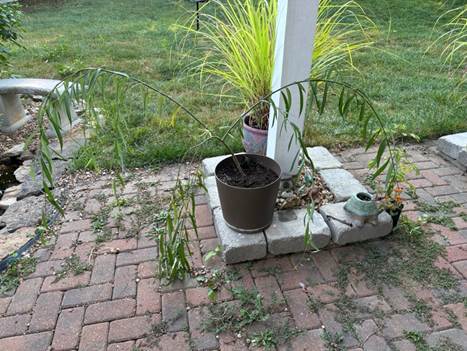
In a modest plastic pot, a small plant sways slightly in the breeze. Above are clear blue sky and streaming sunlight. Sparrows serenade the flowing sapling amidst the ambience of a trickling waterfall. It’s difficult to imagine now, but this small leafy pillar may one day be a swooping willow tree, with lofty tendrils cascading down in layers. Beyond this willow tree’s remarkable beauty, its DNA carries a rich history, stories spanning centuries. There is a hidden heritage within this tree, memories encapsulating various times and spaces. Whenever I step on to my back patio, I observe it and remember its significance. Though its appearance is small and ordinary, this willow tree is a testament of the dually extraordinary and unifying experience of human life.
Though every plant is arguably significant, each a complex and creative masterpiece essential to human life, this willow is particularly exceptional because its origins are traceable and, interestingly, famous. This tree dates to 19th century France where Napoleon Bonaparte ruled as First Consul and, later, as Emperor. During Napoleon’s reign, the world shifted its gaze westward, towards the developing United States (U.S.). While the fledgling U.S. nation navigated newfound growing pains, the willow became a part of its history. And even today, the tree’s legacy continues in my family.
The willow tree begins its journey at the end of Napoleon Bonaparte’s. Planted at his gravesite, the willow here is a solemn reminder of Napoleon’s role as a leading figure in the years following the French Revolution. Napoleon’s influence was widespread, reaching beyond the confines of France. Importantly, he sold his Louisiana territory to the U.S. when raising funds for his Napoleonic Wars. This transaction, commonly referred to as the Louisiana Purchase, had major ramifications for Americans; positively, it provided more land and resources, yet it also ignited conflicts within the young country (History.com editors, “Napoleon Bonaparte”). In this way, Napoleon’s life exemplifies the potential ripple effect of one person’s actions; on a global scale, Napoleon’s experience and his significant contribution to U.S. history demonstrate how people have the capacity to contribute meaning in a vast world. Despite great military successes, Napoleon’s authority eventually deteriorated, and his French enemies exiled him to Saint Helena, an island owned by Britain, where he died. Like his actions, the willow tree planted above his gravesite persists in the lives of subsequent generations.
The willow’s journey continues approximately 30 years after Napoleon’s death, in 1821, when a certain Captain William Francis Lynch came upon a fitting gift for then U.S. president, Andrew Johnson (The Editors of Encyclopaedia Brittanica, “Andrew Johnson”). Lynch took a clipping from the willow at Napoleon’s grave and delivered it to Johnson. Johnson then planted it at his homestead in Greenville, Tennessee. President Johnson was a notable figure amidst reconstruction efforts following the tragic Civil War. Although he undertook an important role, he had humble origins in Greenville. The tree’s placement in Greenville showcases Johnson’s history, not only memorializing him for his impressive role, but also highlighting his modest upbringing. Later, the willow at Napoleon’s gravesite died, and historians sent a portion of Johnson’s tree back to Saint Helena. The tree, wrapped in an issue of The Greenville Sun newspaper and soaked in spring water from Johnson’s homestead, returned to its original site, carrying with it another individual’s unique story (“Historic Trees”).
In 21st century America, the willow’s story progresses beyond these two historical figures. In the early 2000s, Manuel, a historic preservationist who worked at Johnson’s Tennessee homestead, collected a few clippings from the famous willow. At that point, the tree had become a valuable historical artifact. By virtue of its past associations, it was more than a simple factor in an ecosystem; it was as a cache of precious memories, a symbol of human life. When work beckoned Manuel to Melrose, an old Southern home in Mississippi, he gifted a clipping to his new coworker, Lynda. For Lynda and Manuel, the tree’s association with President Johnson and the Civil War was particularly meaningful, given their professions as caretakers of American historical sites. Indeed, the willow conveys a repeated narrative of rebellion and restoration; both Napoleon and Johnson encountered rebellion, though from different perspectives. Nonetheless, both instances paved the way for a time of restoration. Thus, the willow serves as a reminder of the paradoxical complexity and repeatability of human experiences; it displays the nuances in history while affirming shared experiences.
In early June of 2025, with my mom and grandma, I took a trip to Weston, a small town on the outskirts of Kansas City. We visited my five-year-old cousin, Alistair, and his mom, Lynda. In their secluded backyard, spewing with vines and mosses and vegetation, stood a lofty willow tree. It’s the centerpiece of the yard, and its arms hang protectively around it. I stood and admired it, remembering nights of my childhood spent collecting fireflies as I wove through its enchanting leaves. I don’t remember much about previous visits to my aunt Lynda’s house because I was so young, but I will never forget the magic of the willow tree, once only a tiny slip from Manuel.
Bidding Lynda and Alistair farewell, we traveled home with a special treasure, a clipping of the famous willow, a legacy of human history. Our tree is still small and young, but it is also old and imbued with stories. It marks the resting place of Napoleon, a man acquainted with ambition and despair. It recalls the modest childhood of Johnson, a man eventually burdened with the monumental task of reconciling a country in the wake of civil war. It teaches lessons about generosity; Lynch gifted it to Johnson; Americans restored it at Napoleon’s grave; Manuel shared it with Lynda; and Lynda shared it with my family. Humanity’s connectedness as well as each human’s uniqueness are evident in the memories they create. Perhaps these memories are more accessible than some presume. Memories are not tucked away in one’s mind or only selectively preserved in history books. Rather, they are woven into the fabric of the world, in nature, and they are revealed in interactions, through storytelling. Humanity touches its environment in lasting ways, and we may all benefit from taking time to wonder as we observe the influence of people in the landscapes around us.
Works Cited
“Historic Trees President Johnson’s Willows.” Tennessee’s Wild Side, Rock Water TV, wildsidetv.com/historic-trees-president-johnsons-willows/
History.com editors. “Napoleon Bonaparte.” History, A&E Television Networks, 9 Nov. 2009, http://www.history.com/articles/napoleon#Napoleon’s-Rise-to-Power
The Editors of Encyclopaedia Brittanica. “Andrew Johnson.” Encyclopaedia Britannica, Encyclopaedia Britannica, inc., 12 July 2025, www.britannica.com/biography/Andrew-Johnson
Lucy Quagliata is an undergraduate student at Lindenwood University, majoring in Business Administration and minoring in English and Spanish. She has a passion for writing because it allows for rich and impactful communication. As a writer, much of her inspiration comes from her Christian faith, and she aspires to convey glimpses of the human experience through her story telling. Whatever her future holds, her hope is to inspire audiences and invoke genuine thoughtfulness through her personal contributions.


Leave a comment